
VIP member

Inner Mongolia Yili (dairy industry) refrigeration room ammonia leakage detection system solution
Inner Mongolia Yili (dairy industry) refrigeration room ammonia leakage detection system solution HA8600 main features application areas technical par
Product details
Inner Mongolia Yili (dairy industry) refrigeration room ammonia leakage detection system solution
HA8600
HA8600
Main Features
Application field
Technical Specifications
Product manual download
Qualification Certificate
1、Testing requirements
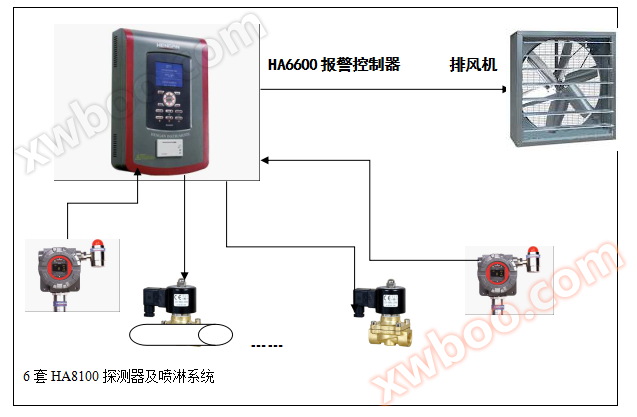
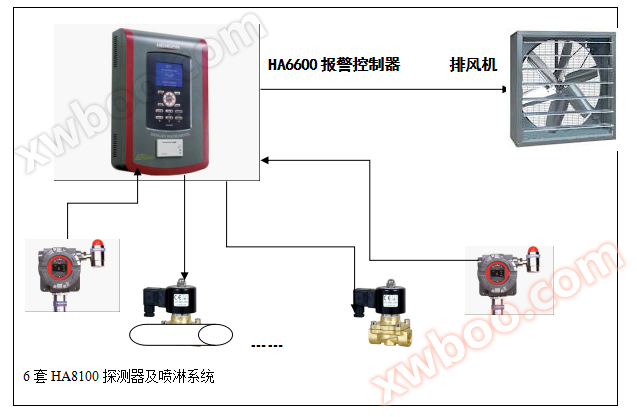
according toInner Mongolia Yili Industrial Group Co., LtdThe on-site requirements provided are to install 6 ammonia leak detection device probes and 6 automatic sprinkler heads in the refrigeration room. The alarm and control devices corresponding to each probe should be centrally installed in the refrigeration control room using wall mounted technology, and the control devices should be able to emit sound and light alarms. System connection and working mode: 1 gas detection controller is configured with 6 modular intelligent detection detectors, each connected separately1 pieceSprinkler head, when the ammonia concentration detected by a detector reaches the alarm value, the relay drives the corresponding sprinkler head to spray the area, dilute the ammonia concentration, and the sprinkler in other areas will not start. In addition, the alarm device works in conjunction with the fan, and when the alarm device is activated, the fan also starts simultaneously.
2、System design concept
The design of this system is based on relevant national standards. In areas where process equipment and storage facilities for producing or using combustible gases are generally required, toxic gas detection and alarm devices should be installed in accordance with the following specifications:
Combustible gas or toxic gas contained therein, once leaked, may reach 25% LEL. However, if the toxic gas cannot reach the maximum allowable concentration, a combustible gas detection alarm should be installed.
Toxic gas or combustible gas contained in it, once leaked, may reach the maximum allowable concentration of toxic gas, but when the combustible gas cannot reach 25% LEL, a toxic gas detection alarm should be installed.
It belongs to both flammable and toxic gases, and only toxic gas detection and alarm devices are installed.
In places where combustible gases and toxic gases coexist, combustible gas and toxic gas detection and alarm devices should be installed simultaneously.
Combustible gas and toxic gas detection alarms should be classified as level one or level two alarms. Conventional detection alarms should be level one alarms. When the process requires the adoption of an interlocking protection system, first level and second level alarms should be used.
Combustible gas detection and alarm devices must be certified by national designated institutions and authorized inspection units based on their manufacturing, explosion-proof performance, and fire safety certifications. Toxic gas detection and alarm devices must be certified by the manufacturing of measuring instruments by designated national institutions and authorized inspection units. Explosion proof toxic gas detection and alarm devices should also be certified for their explosion-proof performance by designated national institutions and authorized inspection units.
Within the effective coverage area, one detector can be installed. The distance between the toxic gas detector and the release source should not be greater than 2 meters outdoors and 1 meter indoors. Fixed gas or toxic gas detection and alarm devices should be used in places where they are installed. The combustible gas and toxic gas detection and alarm system should be a relatively independent instrument system. Based on the actual situation of your company, it is recommended to install 6 ammonia detectors HA8100 in the refrigeration room, which should adopt the principle of electrochemical detection; One gas detection controller is equipped with six modular intelligent detection detectors, each connected to one sprinkler head. When the ammonia concentration detected by one detector reaches the alarm value, the relay drives the corresponding sprinkler head to spray the area, diluting the ammonia concentration. Spraying in other areas will not be activated. In addition, the alarm device works in conjunction with the fan, and when the alarm device is activated, the fan also starts simultaneously.
3、Principle and System Scheme Diagram of Gas Monitoring System
The gas monitoring system consists of a gas monitor, a gas alarm controller, a fire sprinkler system composed of external solenoid valves, manual shut-off valves, nozzles, pipelines, etc., and a fan linkage system composed of intermediate relays and fans.
3.1Gas monitor
The gas monitor consists of a gas sensor, transmitter, and sound and light alarm. Install gas alarm detectors for corresponding gas types in situations where monitoring of gas concentration in the air is required. Each gas alarm detector is equipped with an audible and visual alarm. When the gas concentration exceeds the set alarm concentration value, the gas alarm detector will send back the detection value to the controller and activate its own audible and visual alarm to remind on-site personnel to pay attention.
3Gas alarm controller
Each gas detector is connected to the gas alarm controller in the sub control center through a 3-core multi strand copper cable. The HA6600 series gas alarm controller from Zhongheng'an can connect up to 16 gas detectors per unit.
The gas alarm controller judges and processes the gas concentration values collected by each gas alarm detector, emits sound and light alarm signals, reminds the personnel in the duty room to pay attention, and can control the corresponding equipment through the output of the alarm relay.
Online inquiry
-
Contacts
-
Company
-
Telephone
-
Email
-
WeChat
-
Verification Code
-
Message Content
-