
VIP member
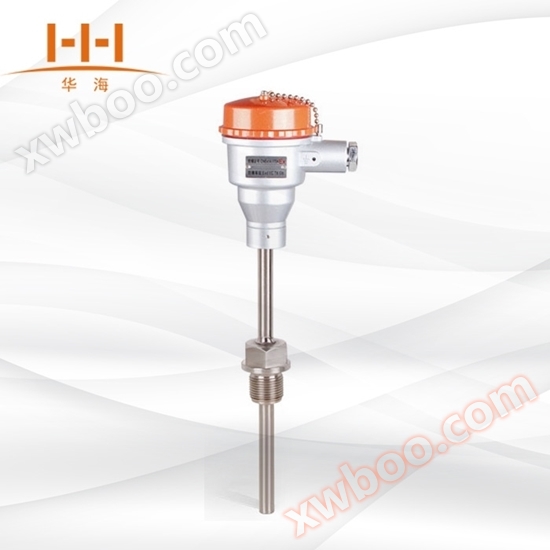
WRNK-240 Fixed Thread Explosion proof Armored Thermistor
Armored thermal resistance can directly measure and connect various liquid, steam, gas media and solid surface temperatures ranging from -196 ℃ to 850
Product details
WRNK-240 Fixed Thread Explosion proof Armored Thermistor
Ten years of sharpening a sword, actively striving for excellence, only for you with high quality
|
Working principle
The structure and principle of explosion-proof thermocouples are basically the same as those of prefabricated thermocouples. The difference is that the explosion-proof product junction box (housing) adopts a special explosion-proof structure in the design. The junction box is made of high-strength aluminum alloy die-casting, and the well has sufficient internal space, wall thickness, and mechanical strength. The thermal stability of the rubber sealing ring meets the national explosion-proof standards. So, when the explosive mixed gas inside the junction box explodes, its internal pressure will not damage the junction box, and the resulting heat energy cannot spread or explode outward.
Main technical indicators
Temperature measurement range and allowable error
|
| model | Graduation | measuring range | accuracy class | Allowable deviation △ t ℃ |
| WZP WZP2 WZPK WZPK2 |
Pt100 | -200~500 | A-level | ±<650℃ ±(0.15+0.002∣t∣) |
| Grade B | -Allowable deviation at 200-800 ℃ ± (0.30+0.005 ∣ t ∣) |
|
Note: "t" represents the absolute value of the measured temperature of the temperature sensing element, and the dual platinum resistance is only supplied to Class B.
nominal pressure
Generally refers to the static external pressure that the protective tube can withstand at room temperature without breaking, and the test pressure gauge generally uses 1 In fact, the allowable working pressure is not only related to the material, diameter, and wall thickness of the protective tube, but also to its structural form, installation method, insertion depth, and the flow rate and type of the measured medium.
Thermal resistance insulation resistance
The test voltage for insulation resistance at room temperature can take any value from 10 to 100V DC, and the ambient temperature should be within the range of 15 to 35 ℃, with a relative temperature not exceeding 80%. The insulation resistance value at room temperature should not be less than 100M Ω.
Thermal resistance allows current to pass through
The maximum current measured through a platinum resistor shall not exceed 5mA
Explosion proof type and level group
Explosion proof level group: d II BT4 or d II CT4
Explosion proof Marking Method for Explosion proof Thermistors
|
|
Description of categories, levels, and temperature groups of electrical equipment
Electrical equipment is divided into two categories: Category I - Electrical equipment used underground in coal mines
Explosion proof grade
The explosion-proof level of explosion-proof thermocouples is divided into three levels: A, B, and C, based on the maximum safe gap or minimum ignition current ratio applicable to explosive gas mixtures.
Temperature group
The temperature groups of explosion-proof thermocouples are divided into six groups, T1 to T6, according to the highest surface temperature of their exposed parts.
|
| Temperature group | Maximum allowable surface temperature ℃ |
| T1 | 450 |
| T2 | 300 |
| T3 | 200 |
| T4 | 135 |
| T5 | 100 |
| T6 | 85 |
Please refer to the example table of explosion-proof thermocouples for the combustible gas, vapor level, and temperature group of explosion-proof platinum resistors.
Product selection
Install fixed devices
Installation of fixed devices can be divided into three forms: fixed threads, tapered fixed threads, and fixed flanges. The structural dimensions are shown in the table.
| Used to protect the diameter D of the tube | MhS | h | h | D0 | Flow velocity m/s | Maximum operating pressure (MPa) | |||
| Φ12 Φ16 |
M27×2 | 32 | 32 | Φ40 | 10 | ||||
| M33×2 | 33 | 36 | Φ48 | 80 | 30 | ||||
| Φ12 Φ16 |
D2 | D1 | D0 | d0 | H | h | 6.4 | ||
| Φ95 | Φ65 | Φ45 | Φ14 | Φ14 | 2 | ||||
Types and specifications of explosion-proof armored thermal resistors
Explosion proof armored thermistor
| type | model | Graduation | Temperature measurement range ℃ | Protective tube diameter D | thermal response time τ0.5S |
Nominal pressure MPa | structure characteristics | specifications | Explosion proof grade | |
| Total length L | Insertion depth/mm | |||||||||
| Platinum thermistor | WZPK-24 WZPK2-24 |
Pt10 Pt100 |
-200~+500 | Φ6 perhaps Φ5 |
≤12 ≤8 |
10 | explosion - proof connection box Fixed thread installation M27×2 |
150 200 300 400 500 750 1000 |
d Ⅱ BT4 d Ⅱ BT6 perhaps d Ⅱ CT4 d Ⅱ CT6 |
|
| WZPK-44 WZPK2-44 |
6.4 | explosion - proof connection box Fixed flange installation |
||||||||
Applicable medium for explosion-proof thermocouples
★ Explosion proof level and temperature group of flammable gases and vapors:
| order | Explosion proof grade IIA | Explosion proof grade IIB | ||
| Media name | Temperature group | Media name | Temperature group | |
| 1 | Methane, ethane, propane, kinetic benzene | T1 | propyne | T1 |
| 2 | Benzene, toluene, xylene, trimethylbenzene | cyclopropene | ||
| 3 | Phenol, cresol, bisketol | hydrogen cyanide | ||
| 4 | Acetone, butanone, pentanone, diketone | hydrogen | ||
| 5 | Acetic acid, methyl acetate, chloroethane, bromoethane | Acrylic | ||
| 6 | Chloroethylene, dichloroethylene, trichlorotoluene | coke oven gas | ||
| 7 | Dichloromethane, dichloropropane, chlorobenzene, ammonia | water gas | ||
| 8 | Carbon monoxide, benzyl chloride, dichlorobenzene | ethylene | T2 | |
| 9 | Toluene, triethylamine, pyridine | butadiene | ||
| 10 | Ethyl acetate | Epoxypropane | ||
| 11 | Styrene, methyl styrene, naphthalene | Dioxane | ||
| 12 | Butane, cyclopentane, methylcyclopentane | T2 | Trioxane | |
| 13 | Isopropyl benzene, methyl, methanol to butanol | methyl acrylate | ||
| 14 | Methyl methacrylate, ethyl acetyl acetate | ethyl acrylate | ||
| 15 | N-propylamine, n-butylamine, aniline, NN dimethylaniline | furan | ||
| 16 | Methyl formate, ethyl formate | dimethyl ether | T3 | |
| 17 | Dichloroethane, allyl chloride, chloroethanol, thiophene | tetrahydrofurfuryl alcohol | ||
| 18 | Methylamine, dimethylamine, diethylamine | hydrogen sulfide | ||
| 19 | Acetylacetone, cycloethanol, nitromethane, nitroethane | acrolein | ||
| 20 | Acrylic, ethylbenzene, methyl acetate to pentyl acetate | T3 | Crotonaldehyde | |
| 21 | Methyl cyclohexane, turpentine, naphtha | Tetrahydrofuran | ||
| 22 | Pentane to decane, cyclohexane, naphthalene, cyclohexylamine | ethyl methyl ether | T4 | |
| 23 | Ethyl cyclohexane, ethyl cyclohexane, ethyl cyclopentane | diethyl ether | ||
| 24 | Petroleum, gasoline, diesel, kerosene, coal tar | dibutyl ether | ||
| 25 | Pentanol, hexanol, cyclohexanol, methyl cyclohexanol | ethylene oxide | ||
| 26 | Chloropropane, chlorobutane, bromobutane | Tetrafluoroethylene | ||
| 27 | Acetyl chloride, ethyl mercaptan, tetrahydrothiophene | carbon disulfide | T5 | |
| 28 | Acetaldehyde, trimethylamine | T4 | Ethyl nitrate | T6 |
|
Enterprise Honor and Qualification
On site map of equipment factory
Customers use on-site maps
Buyers must-read
Shipping Notice
|
Online inquiry
-
Contacts
-
Company
-
Telephone
-
Email
-
WeChat
-
Verification Code
-
Message Content
-